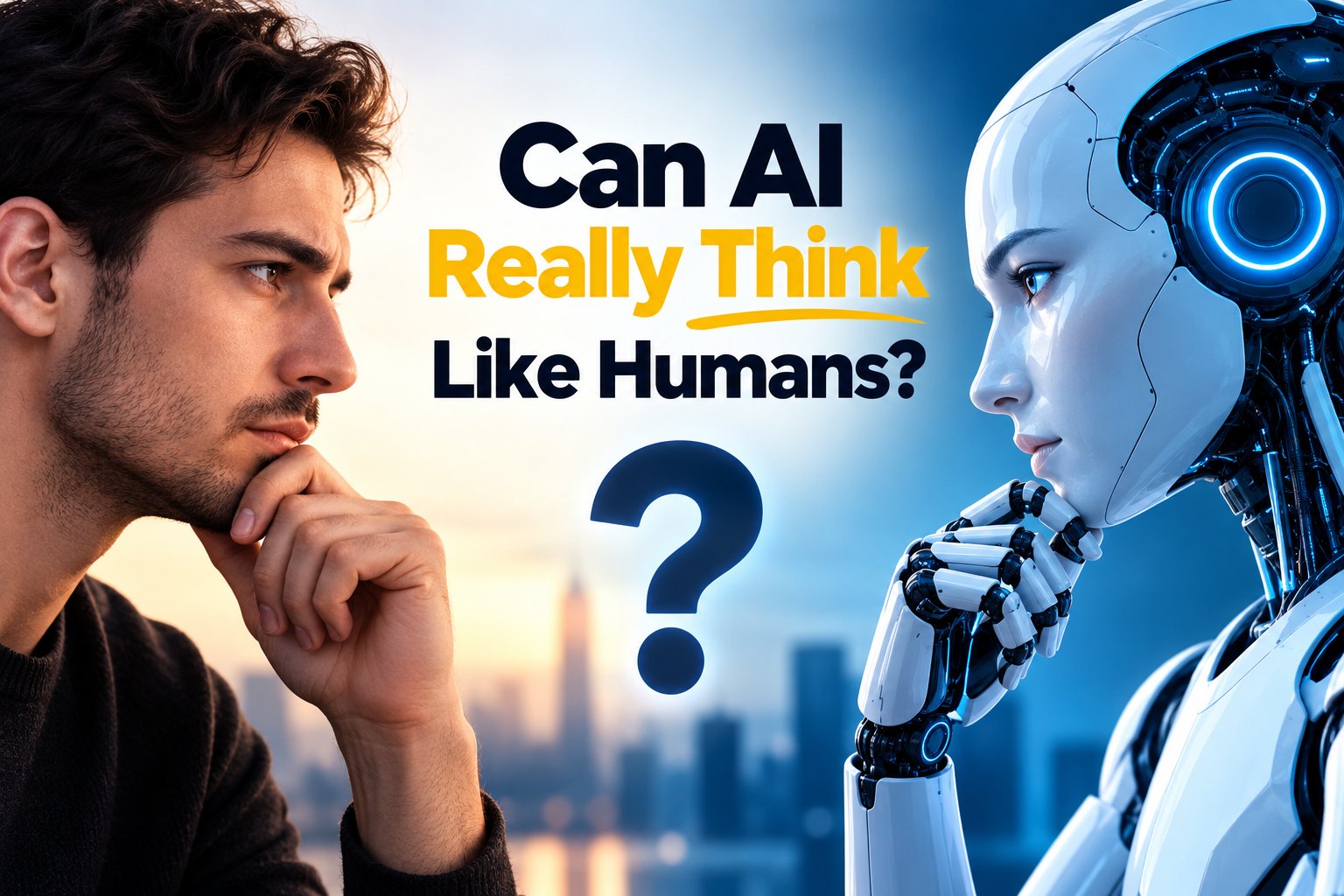
Can AI Really Think Like Humans?
Artificial intelligence has become surprisingly good at doing things that once seemed uniquely human. It can write articles, create images, solve mathematical problems, translate languages, analyze information, and even hold conversations that feel remarkably natural.
That raises an interesting question: Can AI really think like humans?
At first glance, it can certainly seem that way. Ask an AI a difficult question and it may give you a detailed answer within seconds. Give it a complicated problem and it can break the problem down, compare different possibilities, and suggest a solution.
But looking intelligent and actually thinking like a human are not necessarily the same thing.
AI can imitate many aspects of human thinking, but there are still major differences between the way artificial intelligence processes information and the way people experience the world.
What Does It Mean to Think Like a Human?
Before comparing AI with humans, it helps to understand what we actually mean by “thinking.”
Human thinking is more than processing information. People use memories, emotions, personal experiences, instincts, imagination, beliefs, and knowledge about the world when making decisions.
For example, imagine someone deciding whether to accept a new job.
They might consider the salary and working hours, but they could also think about their family, previous experiences, personal ambitions, stress levels, relationships with coworkers, and even a feeling that something “doesn’t seem right.”
Much of human thinking happens through a mixture of logic and experience.
AI works differently.
An AI system processes information using algorithms and learned patterns. It can identify relationships in enormous amounts of data and produce useful responses, but it does not experience the world in the same personal way that humans do.
AI Can Solve Problems, But Does It Understand Them?
One of the most impressive abilities of modern AI is problem-solving.
AI systems can analyze complex information and produce answers that appear thoughtful. They can write computer programs, summarize research, compare options, and explain difficult concepts.
However, there is an important difference between producing an intelligent answer and understanding something through human experience.
A person who has experienced failure may understand disappointment in a deeply personal way. An AI can explain what disappointment means, describe how people commonly react to it, and write an emotional story about it.
But explaining an emotion is not the same as experiencing it. This distinction becomes important when we talk about whether AI actually thinks like humans.
AI Doesn’t Experience Emotions Like We Do
Human emotions influence almost everything we do.
Happiness can affect our decisions. Fear can make us cautious. Love can make us take risks. Anger can change the way we communicate. Memories of previous experiences can influence how we react to a completely new situation.
AI does not have emotions in the human sense. It can recognize emotional language and generate a response that sounds sympathetic. If you tell an AI that you are having a difficult day, it may respond in a supportive and understanding way.
That response can still be useful.
But the AI is not sitting there feeling sadness for you or worrying about your situation. It is generating a response based on patterns learned from data and the instructions it has been given.
In other words, AI can simulate emotional understanding without necessarily experiencing emotion itself.
What About Creativity?
Creativity is another area where the difference between humans and AI becomes complicated.
AI can create paintings, write songs, generate stories, design logos, and come up with business ideas. Some of the results can be genuinely impressive.
So, is AI creative? That depends on how we define creativity.
Humans often create things because of personal experiences, curiosity, emotions, memories, cultural influences, or a desire to express something.
An artist might paint a picture because a childhood memory continues to affect them. A writer might create a story after experiencing loss, friendship, love, or adventure.
AI does not have a childhood or personal memories of its own. Instead, it learns patterns from existing material and uses those patterns to generate something new. That can produce original combinations, but the process is fundamentally different from human creative experience.
AI Can Learn, But Not Exactly Like a Person
Another reason AI can appear human-like is its ability to learn. Modern AI models are trained using enormous amounts of information. During training, they learn patterns that allow them to predict and generate useful outputs.
Humans learn differently. A child may learn what a dog is after seeing one, touching it, hearing it bark, and interacting with it. The child connects the concept to a physical experience.
AI can learn what a dog is from huge quantities of text, images, audio, and other information, depending on the system.
Both processes involve learning, but they are not the same. A human develops an understanding of the world through direct experience. AI primarily develops its capabilities through training data and computational processes.
Why Does AI Sometimes Seem So Human?
If AI does not think exactly like us, why can conversations with it feel so natural? The answer is partly language.
Human communication contains patterns. We have common ways of asking questions, explaining ideas, expressing emotions, telling stories, and responding to different situations.
AI systems have been trained on enormous amounts of human-generated information. As a result, they can become extremely good at recognizing and reproducing these patterns.
This is why an AI response can sometimes feel like it came from a person. It understands how language is normally used, even though that does not necessarily mean it has the same kind of consciousness or personal experience behind the words.
Can AI Develop Consciousness?
This is where the conversation becomes much more philosophical. Consciousness refers to the experience of being aware — of having thoughts, sensations, feelings, and an internal experience of the world.
Scientists and philosophers still debate exactly what consciousness is and how it arises in humans.
Because of that, there is no simple test that allows us to say with absolute certainty whether a sufficiently advanced AI system could ever become conscious.
Current AI systems can produce conversations about consciousness and even say things that sound self-aware. But sounding self-aware does not automatically prove that an AI has an inner experience.
A machine saying “I understand” and a human genuinely experiencing understanding may be two very different things.
The Biggest Difference: Human Experience
Perhaps the most important difference between humans and AI is experience.
Humans have bodies. We get tired, hungry, excited, nervous, sick, curious, and emotional. We interact with the physical world from the moment we are born.
Our experiences shape who we become. Two people can go through the same event and remember it differently because each person brings a unique history to the situation.
AI does not have a personal life story in the same sense. It can know about millions of human experiences without having lived those experiences itself. That difference is easy to overlook because AI has become remarkably good at talking about human life.
Does This Mean AI Is Not Intelligent?
Not at all. AI can demonstrate abilities that are extremely impressive and, in some specific tasks, far beyond what an individual human can do.
It can process huge amounts of information quickly, identify patterns, automate complicated workflows, and assist people with tasks that would otherwise take hours.
The mistake is assuming that intelligence has to look exactly the same in humans and machines. AI may be intelligent in ways that are different from human intelligence.
A calculator is better than most people at performing certain calculations, but nobody expects it to understand mathematics in the same way a mathematician does. AI creates a similar challenge on a much larger scale.
What Does the Future Hold?
The relationship between AI and human thinking will probably become even more interesting as the technology develops. Future AI systems may become better at reasoning, planning, remembering context, using tools, and adapting to complicated situations. They may appear even more human-like in everyday interactions.
That does not necessarily mean they will become human. Instead, we may end up with a new category of technology that can perform increasingly sophisticated forms of reasoning without having the same biological experiences that shape human thought.
The more capable AI becomes, the more important it will be to understand what it can actually do — and what we are simply assuming it can do because its responses sound convincing.
Final Thoughts
So, can AI really think like humans? Not in the full human sense — at least based on what we currently understand. AI can analyze information, solve problems, generate creative content, recognize patterns, and communicate in remarkably human-like ways. These abilities can make it seem as though a machine is genuinely thinking.
But human thought involves much more than producing intelligent answers. It is connected to emotions, memories, physical experiences, consciousness, relationships, and a lifetime of personal experiences.
AI may become much better at imitating the way humans reason and communicate. It may even develop capabilities that challenge our current definition of intelligence.
For now, however, the most useful way to look at AI is not as a machine that has simply become another human being. It is a powerful form of technology with its own strengths and limitations.
And perhaps the more interesting question is not whether AI will think exactly like us, but what humans and AI can accomplish when their different abilities are combined.