How AI Agents Are Changing the Way We Work
Artificial intelligence has already changed many parts of our daily lives, but the next big shift is happening in the workplace. Instead of simply answering questions or generating text, AI agents can now take action, work through multiple steps, and help complete tasks with much less human input.
From organizing meetings and handling customer requests to analyzing data and assisting with software development, AI agents are becoming useful digital coworkers. They are not necessarily replacing entire jobs. In many cases, they are changing how people spend their time by taking care of repetitive work and allowing employees to focus on tasks that require judgment, creativity, and communication.
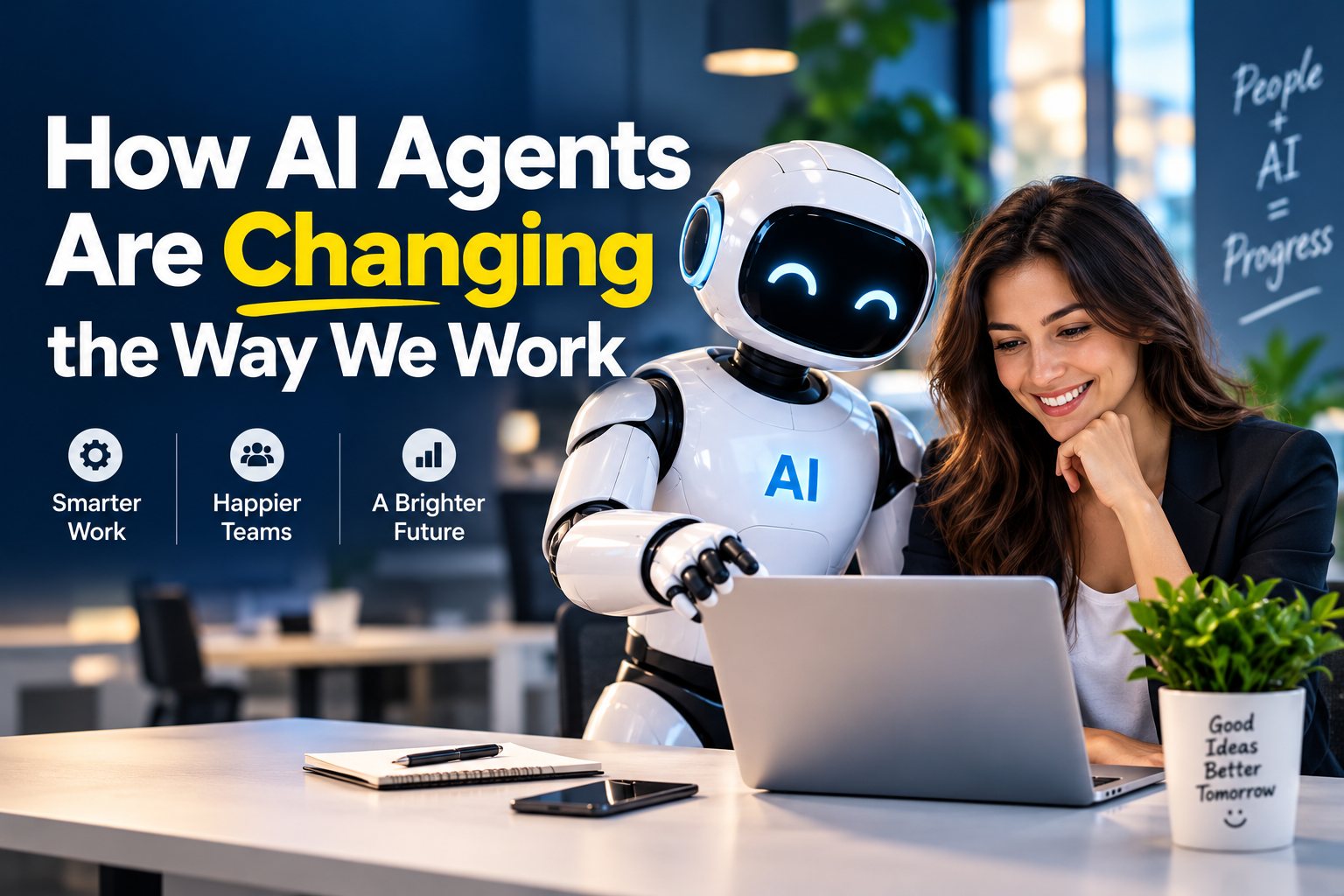
So, what exactly are AI agents, and how are they changing the modern workplace?
What Are AI Agents?
AI agents are software systems designed to understand a goal, make decisions, and take actions to achieve that goal.
A traditional AI tool might answer a question when you give it a prompt. An AI agent can go a step further. It may break a larger task into smaller steps, use different tools, check the results, and continue working until the objective is completed.
For example, imagine asking an AI agent to help prepare a weekly sales report. Instead of simply explaining how to create one, an agent could potentially collect information from connected business systems, organize the data, identify important changes, create a report, and prepare it for review.
This ability to reason through tasks and take action is what makes AI agents particularly interesting for businesses.
Why AI Agents Are Becoming Important
Modern workplaces generate enormous amounts of information every day. Employees deal with emails, documents, meetings, customer messages, spreadsheets, reports, and countless small administrative tasks.
Much of this work is necessary, but not all of it requires a person to spend hours doing it manually.
AI agents can help reduce this workload.
Rather than using AI only as a search or writing assistant, companies can use agents to support complete workflows. This can save time, reduce repetitive work, and help teams respond faster.
The biggest change may not be that AI does everything on its own. Instead, it can give employees more time to concentrate on the work where human experience matters most.
1. AI Agents Are Automating Repetitive Tasks
One of the clearest ways AI agents are changing work is through automation.
Many employees spend a significant portion of their day performing repetitive activities such as:
- Sorting emails
- Entering information into systems
- Creating routine reports
- Scheduling meetings
- Organizing documents
- Updating records
- Following up with customers
- Summarizing lengthy information
These tasks may seem small individually, but they can consume hours over the course of a week.
An AI agent can potentially handle several of these steps automatically. For example, an agent could review incoming customer requests, identify the type of request, find relevant information, prepare a response, and send it to an employee for approval.
The employee remains in control, but much of the routine preparation has already been completed.
2. AI Agents Are Changing Customer Service
Customer support is another area where AI agents are making a noticeable difference.
Basic chatbots have existed for years, but newer AI systems can understand conversations more naturally and work with information from different sources.
An AI agent could help a customer find an order, explain a company’s return policy, answer common questions, or escalate a complicated issue to a human representative.
This creates a different model of customer service.
Instead of human agents spending most of their time answering simple questions, AI can handle routine requests while employees focus on cases that require empathy, negotiation, or careful decision-making.
That can benefit both businesses and customers when the system is designed properly.
3. AI Agents Can Help Employees Make Better Decisions
AI agents are not only useful for automation. They can also help people process information more quickly.
Consider a manager who needs to understand why sales have changed over the past few months. Normally, they might have to review several spreadsheets and reports before finding useful patterns.
An AI agent could help collect and organize the relevant information, highlight unusual changes, and present potential explanations.
The final decision still belongs to the manager, but the agent can reduce the amount of manual analysis required before making that decision.
This distinction is important.
AI can assist with decision-making without necessarily replacing human judgment.
People still need to consider business goals, risks, company culture, customer relationships, and other factors that may not be obvious from data alone.
4. AI Agents Are Becoming Digital Assistants
The idea of a digital assistant is not new, but AI agents are making these assistants much more capable.
A traditional digital assistant might remind you about a meeting. A more advanced AI agent could help prepare for that meeting by reviewing previous notes, organizing relevant documents, creating a summary, and highlighting outstanding tasks.
For professionals who deal with large numbers of meetings, messages, and documents, this type of assistance could become extremely valuable.
The workplace assistant of the future may not simply respond when someone asks a question. It may proactively help organize work and identify what needs attention.
5. AI Agents Are Changing Software Development
Software development is another field where AI agents are having an impact.
Developers can already use AI tools to generate code, explain errors, write tests, and document software. AI agents take the idea further by helping with larger development workflows.
For example, an agent may be able to analyze a software issue, inspect relevant code, suggest a solution, create changes, run tests, and report the results.
Developers still need to review the work carefully. AI-generated code can contain bugs, security problems, or design choices that do not fit a particular project.
However, when used responsibly, AI agents can reduce the amount of repetitive coding work and allow developers to spend more time solving complex technical problems.
6. Small Businesses Can Benefit Too
AI agents are not only useful for large corporations.
Small businesses often have limited staff, which means owners and employees may have to handle many different responsibilities themselves.
An AI agent can potentially help with tasks such as customer communication, appointment scheduling, content preparation, lead management, basic research, and administrative work.
This can make advanced automation more accessible to smaller teams.
For a business owner, saving even a few hours each week can make a meaningful difference. Instead of spending that time on repetitive administration, they can focus on customers, strategy, products, and business growth.
7. AI Agents Could Change What Employees Focus On
Perhaps the most important effect of AI agents is not automation itself. It is the potential shift in how people spend their working hours.
If AI handles more repetitive tasks, employees may have more time for:
- Creative thinking
- Problem-solving
- Strategy
- Communication
- Leadership
- Building relationships
- Learning new skills
- Making important decisions
This could make some jobs more interesting and productive.
However, the transition will not be identical for everyone. Some roles may change significantly, while others may see only limited use of AI.
The people who understand how to work effectively alongside AI are likely to have an advantage as these technologies become more common.
The Human Side of AI Agents
Despite their capabilities, AI agents are not perfect.
They can misunderstand instructions, produce incorrect information, make poor assumptions, or fail when a task involves unusual circumstances.
That is why human oversight remains important.
Businesses should not treat AI agents as systems that can automatically make every important decision. Instead, they should establish clear boundaries around what an agent can do independently and what requires human approval.
For sensitive areas such as finance, hiring, legal decisions, security, or personal information, additional safeguards may be necessary.
The goal should be to combine the speed and scalability of AI with human responsibility and judgment.
Are AI Agents Going to Replace Jobs?
This is one of the biggest questions surrounding workplace AI.
The answer is more complicated than simply saying yes or no.
Some individual tasks will almost certainly become automated. In certain industries, this could reduce the amount of human labor required for particular activities.
At the same time, new responsibilities and roles can emerge around AI systems. Employees may need to supervise agents, check their results, manage AI-powered workflows, or develop new processes around them.
Historically, technology has often changed jobs rather than simply eliminating every role associated with a particular task.
The more useful question may therefore be:
Which parts of a job can AI handle, and which parts still benefit from human skills?
That perspective helps businesses prepare for change without assuming that every job will disappear.
Challenges Businesses Need to Consider
AI agents offer significant opportunities, but adopting them without planning can create problems.
Accuracy
AI systems can make mistakes. Important outputs should be reviewed when errors could have serious consequences.
Privacy
Companies need to understand what information an AI system can access and how sensitive data is handled.
Security
Giving an AI agent access to business systems creates new security considerations. Permissions should be limited to what the agent actually needs.
Cost
Although AI can save time, implementing and maintaining advanced systems can also involve software, infrastructure, training, and management costs.
Human Oversight
Organizations need clear rules for when AI can act independently and when a person must approve an action.
Addressing these issues early can help companies get more value from AI while reducing unnecessary risks.
How Workers Can Prepare for an AI-Powered Workplace
Employees do not necessarily need to become AI engineers to benefit from this technology.
A good starting point is understanding how AI can support the tasks already performed in a particular role.
Workers can begin by identifying repetitive activities, learning the AI tools relevant to their industry, and developing the ability to review AI-generated results critically.
Human skills will also remain important.
Communication, creativity, leadership, critical thinking, relationship building, and domain expertise are difficult to replace with automation alone.
The strongest professionals may be those who combine these human skills with the ability to use AI effectively.
What Does the Future of Work Look Like?
AI agents are still developing, and their capabilities will continue to evolve.
In the future, people may work with multiple specialized AI agents instead of using one general-purpose assistant. One agent might handle research, another could manage scheduling, while another helps analyze business data.
These systems could potentially work together as part of larger automated workflows.
That does not mean the workplace will become completely automated.
Human employees will still need to set goals, make important decisions, handle complex situations, and take responsibility for outcomes.
The workplace of the future may therefore look less like humans versus AI and more like humans working with AI.
Final Thoughts
AI agents are changing the way we think about workplace automation. Instead of simply providing information, they can help complete multi-step tasks, interact with business systems, and support employees throughout their daily workflows.
For businesses, this can mean greater efficiency and faster processes. For employees, it could mean less time spent on repetitive work and more time available for creative and strategic responsibilities.
But successful AI adoption will depend on more than technology. Companies will need responsible policies, human oversight, data protection, and employees who understand how to work effectively with AI.
The future of work is unlikely to be about replacing every human task with a machine. It is more likely to be about finding the right balance between human judgment and artificial intelligence.
And as AI agents continue to improve, that balance could become one of the defining features of the modern workplace.